AI Policy Drafting & Management for Fintechs
AI can produce a policy in seconds. The question for a regulated fintech is whether every sentence can be defended to an inspector. Four rules separate a usable draft from a liability.
Short answer. AI is useful for drafting compliance policies only when it is held to the standard an inspector applies: every statement of what the regulator requires must trace to the regulator's own words, the rules must be the ones addressed to your licence, your firm's facts must come from your firm, and a named person must approve the result. Without those four rules, an AI draft is faster to produce and slower to defend.
Why template and chatbot drafting fails
Most policy drafting shortcuts fall into two kinds. Templates are generic documents written for no regulator in particular. General-purpose chatbots produce fluent text on request. Both fail regulated firms in the same three ways.
Invented obligations
A chatbot asked for an AML policy will write "the regulator requires" followed by a plausible sentence. Sometimes the requirement exists. Sometimes it is a blend of several regimes, or a number nobody wrote down. A compliance officer then has to check every sentence against the source, which is the work the tool was supposed to save, and any sentence missed becomes a commitment the firm never meant to make.
The wrong regulator
Real quotes from the wrong rulebook are harder to spot than invented ones, because they check out. A Singapore fund manager's policy that cites the banks' notice, or a GIFT IFSC policy built on another country's thresholds, reads as well sourced and is wrong. Citation checking alone does not catch it: the quote is genuine, it just does not bind you.
Guidance read as law
Regulators publish guidelines, FAQs and circulars alongside binding notices and regulations. A draft that turns "firms may wish to consider" into "the firm shall" commits you to controls the regulator did not require, and an inspector will hold you to what your policy says.
Four rules for AI drafting you can defend
1. Cite the regulator or stay silent
A sentence is presented as the regulator's requirement only when it carries a quotation that can be found, word for word, in the regulator's text, with the instrument and paragraph named. Where no such quote exists, the sentence is not presented as the regulator's. In Policy Register, a drafted sentence whose quote cannot be found in the source is not tagged as regulator-derived, so a reviewer never mistakes it for the regulator's words.
2. Only rules addressed to your licence
Drafting draws only on instruments for your jurisdiction that are addressed to your type of licence. A fund management company in Singapore gets MAS Notice SFA04-N02 and the guidelines written for it, not the notice for banks. An IFSCA-regulated entity gets the IFSCA instruments that apply to its licence class. Policy Register drafts for IFSCA-regulated entities, and for MAS fund management companies only.
3. Your facts stay yours
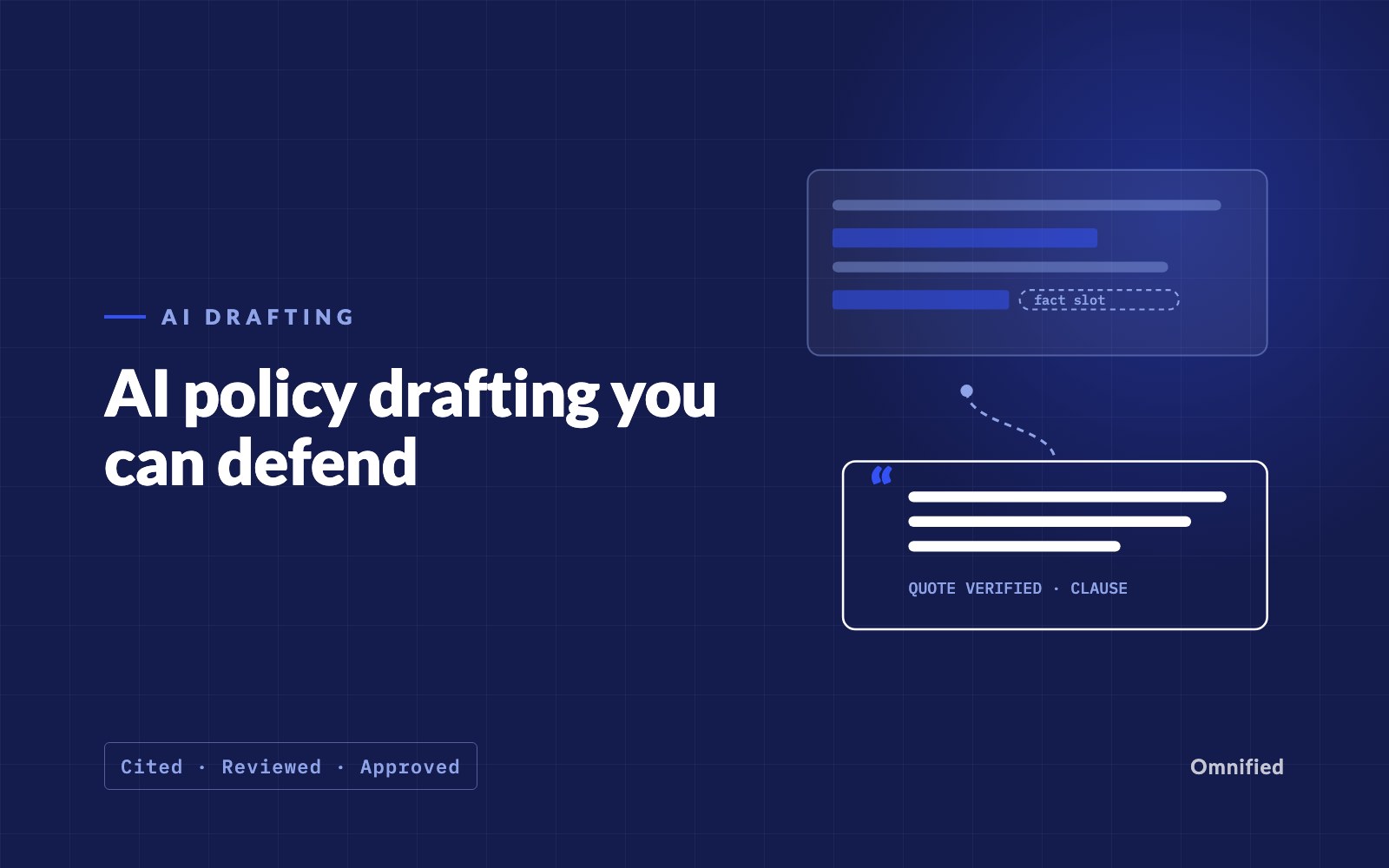
The regulator says what a policy must cover. Your firm decides who the compliance officer is, which onboarding system you use, which third parties you rely on and what your thresholds are. The AI never infers those. Wherever a draft needs a fact only you can supply, it leaves a fact slot: a named placeholder, prefilled from your profile where the value is already known. A version cannot be submitted for approval while a required slot is empty.
4. A human approves
Every AI draft is a proposal. It goes to the same approval queue as a policy you wrote by hand. The person who drafted or edited a version cannot approve it. A policy the regulator expects the board to approve also needs the board resolution and meeting date before it takes effect. There is no path from an AI draft to an effective policy that skips a named approver.
The four visible provenance tags
Approvers do not have time to re-read the rulebook. What they need to see is where each sentence came from. Policy Register marks drafted text with four labels, shown in the editor and the read view:
- Regulator-derived: states a binding requirement and carries the verbatim quote and citation it rests on.
- Regulator guidance: drawn from guidance rather than binding text, and labelled so it is never read as an obligation.
- Entity fact: a fact about your firm, from your profile or a fact slot.
- Firm choice: a decision your firm makes, such as a stricter threshold than the regulator's or a control you chose.
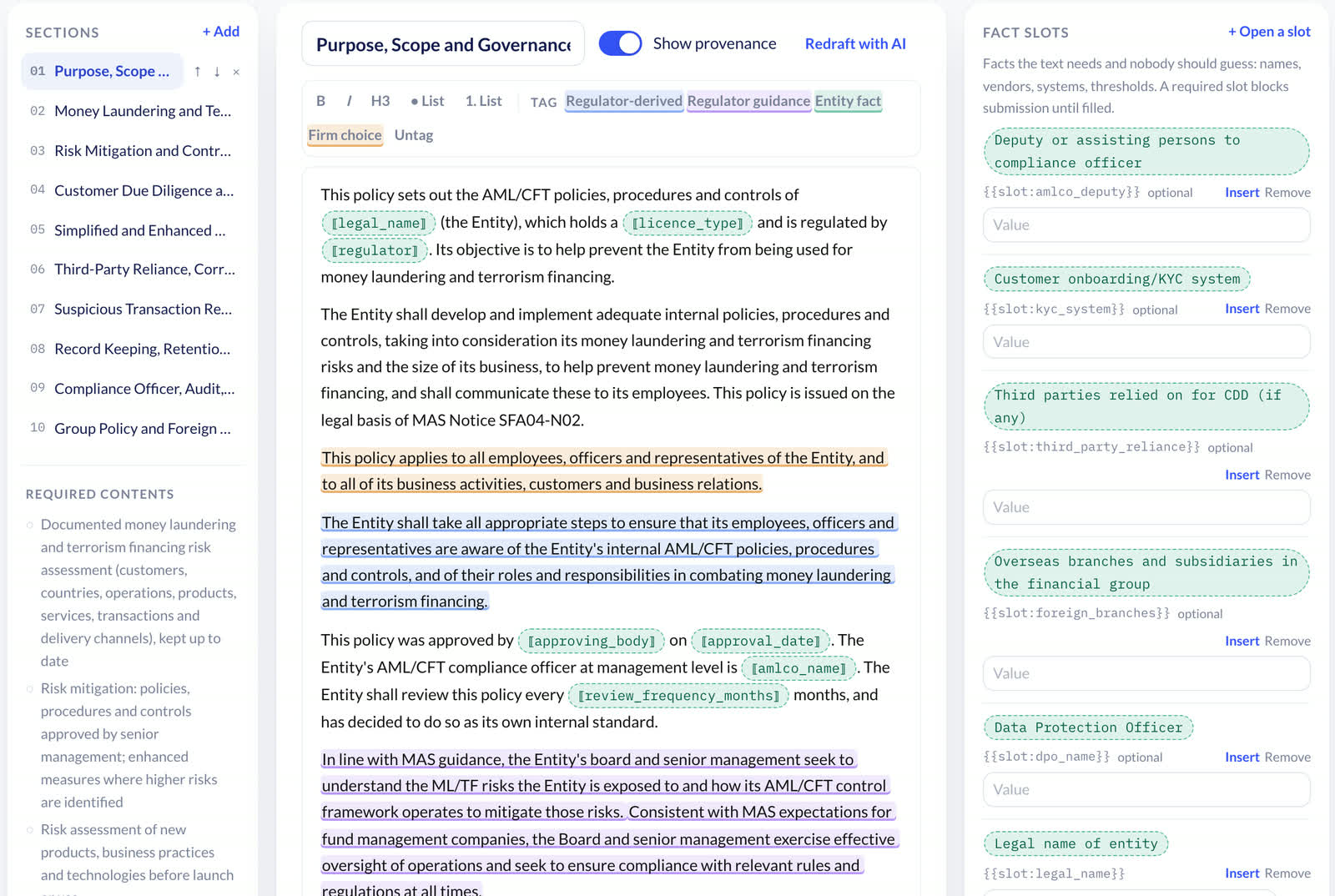
An approver can switch the highlighting on and read a section by its sources: the regulator-derived sentences can be checked against the quotes, and the firm choices are the decisions the approver is actually signing off.
Filling gaps in an existing policy
Most firms do not start from nothing. You upload the policy you already have, as PDF, DOCX, Markdown or text. It goes to approval like any other version. Once it is approved, Policy Register maps it against your obligations and shows, obligation by obligation, what it covers, what it covers only in part and what it misses.
From there, Fill gaps with AI creates a new draft of the policy with one drafted section for each gap or partial you choose, under the same four rules. Your team edits, completes the fact slots, and submits. The policy you approved stays in force until the new version is approved and takes effect.
What a reviewer should check in an AI draft
Provenance tags change what a review is. Instead of reading forty pages for anything that looks wrong, a reviewer works through the draft by tag:
- Regulator-derived sentences: open the quote behind a sample of them and confirm the wording reflects what the clause actually requires of you, not more and not less.
- Regulator guidance: decide whether to adopt each expectation. If you do, it becomes your firm's choice and should read as one.
- Entity facts and fact slots: confirm every name, system and third party, and fill every required slot. The draft cannot be submitted until you do.
- Firm choices: these are the decisions the approver is signing. Check thresholds, timelines and owners against how the business actually runs.
- Untagged text: treat it as your own wording, with no regulator behind it, and edit it as you would any draft.
Comments sit on the section they concern, and sections can be assigned to the people who own the activity, so the person who runs onboarding reviews the onboarding section. When the draft is ready, it goes to approval with the same evidence as any other version.
What the AI never does
- Approve anything, or make any version effective.
- Change an approved or effective policy in place. Changes always arrive as a new draft.
- Invent your firm's facts. Missing facts become slots for your team to fill.
- Present guidance as a binding obligation.
- Cite a regulator's text that is not addressed to your licence.
- Present a sentence it could not verify as the regulator's words.
Keeping an AI-drafted policy current
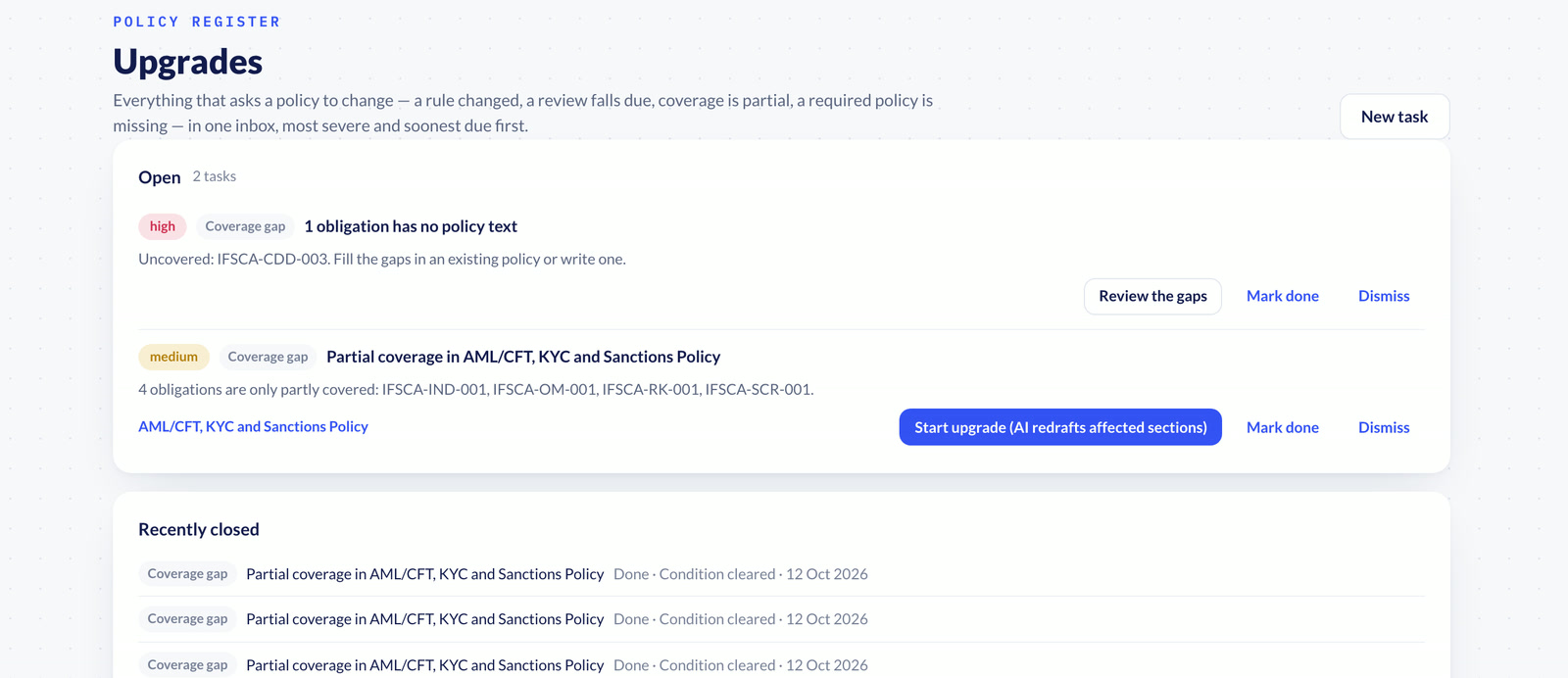
A draft is the easy part; the policy has to stay right for years. Once a policy is approved, its sections stay mapped to the rules they answer. When one of those rules changes, when its review date comes within 30 days, or when coverage shows a section only partly meets an obligation, a task opens in the upgrade inbox. Starting the task creates a new draft in which the AI redrafts only the affected sections, focused on the rule that changed, under the same four rules as the first draft.
Reviewers see the result as a redline against the approved version, so they read what changed rather than the whole policy again. The approved version stays in force until the new one is approved, and the old one is kept, with its dates, as superseded.
Used this way, AI does the part of policy work that is mostly reading and transcribing, and leaves the judgments with the people accountable for them.
Policy Register
Draft from the regulator's own text, for IFSCA-regulated entities and Singapore fund management companies, with every sentence tagged and every version approved by a named person.
See AI drafting with human approval →Frequently asked questions
Can AI write an AML policy?
It can draft one for your team to complete and approve. In Policy Register the AI proposes an outline, then drafts section by section from the regulator's own text; sentences presented as the regulator's carry the quote they rest on, facts only your firm knows are left as slots to fill, and nothing takes effect until a named person approves it.
Which regulators?
IFSCA, and MAS for fund management companies.
Must a human approve?
Yes. Every AI draft goes to the approvals queue. The author of a version cannot approve it, and a board-level policy also needs the board resolution and meeting date. There is no other way for a version to take effect.
What happens when the regulation changes?
When a rule your effective policy is mapped to changes, an upgrade task opens, due by the change's effective date. Starting it creates a new draft in which only the affected sections are redrafted, shown as a redline against the approved version for your approvers.
Related reading
- Compliance policy register with clause-level citations
- How to draft, map and track compliance policies to regulation
- What to demand from policy management software
- About the author, Shubham Khandelwal
Watch a policy being drafted
See a draft built section by section from the regulator's text, then reviewed and approved, on demo data.
Book a demo →General information, not legal advice. An AI draft is drafting assistance; your firm's approver owns the policy. Screenshots show demo data for fictitious entities.
Source: Monetary Authority of Singapore (mas.gov.sg); MAS publications as obtained from the MAS website for the corpus release of 2 September 2026. For the latest version, see mas.gov.sg. Omnified is not affiliated with or endorsed by the Monetary Authority of Singapore. MAS's published text is authoritative and prevails over anything shown here; consult mas.gov.sg.
See the orchestration engine in action.
A guided walkthrough with our team.