Compliance Policy Register with Clause-Level Citations
A folder of PDFs tells an inspector you have policies. A compliance policy register with clause-level citations shows which approved section answers which rule, who owns it, and how you know nothing was altered.
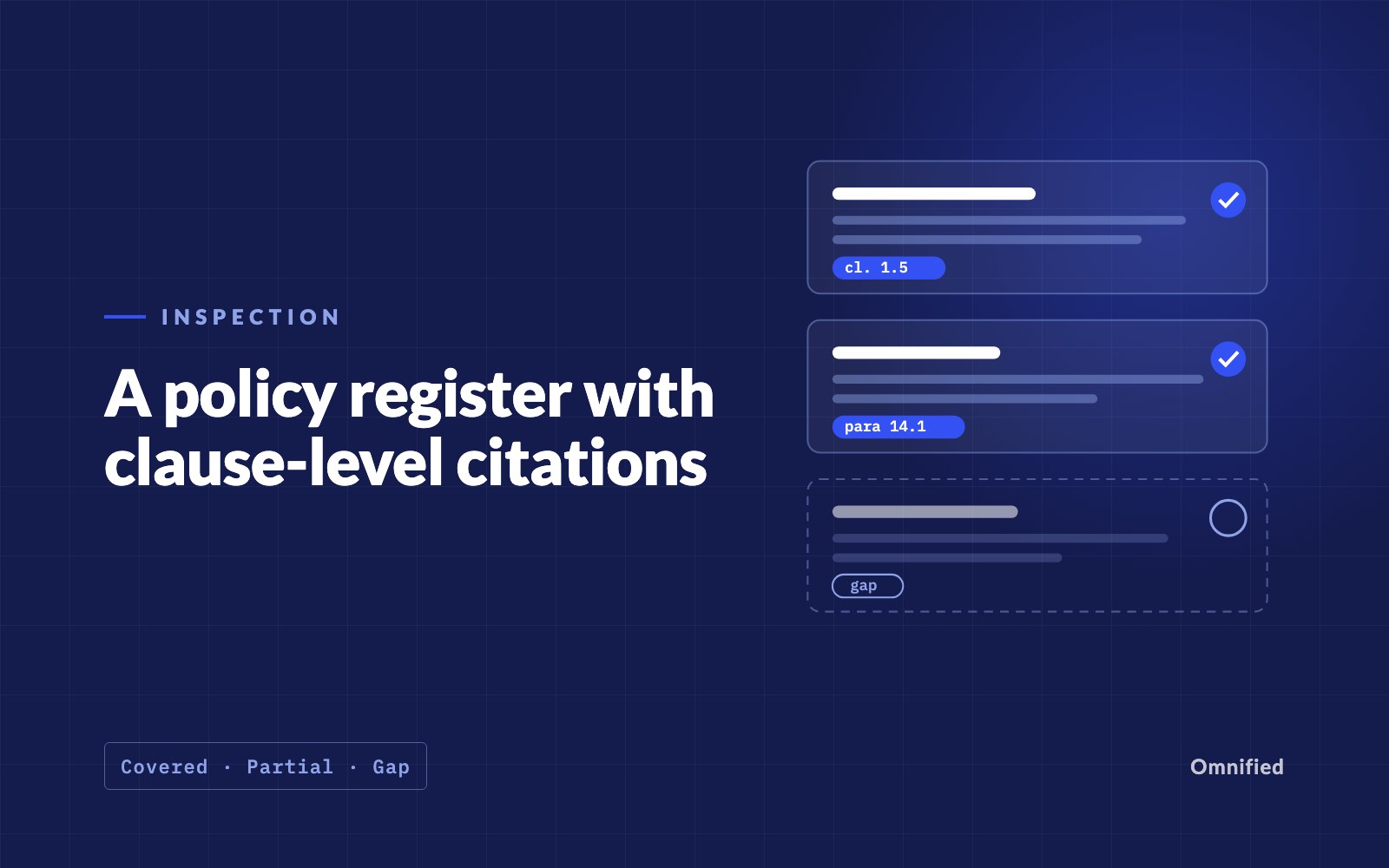
Short answer. A compliance policy register is not a list of documents. It is a list of obligations, each tied to the section of an approved policy that meets it, with the clause it rests on quoted word for word, a verdict on how well it is met, an owner, and a record of every change. That is what lets you answer an inspector's question in the room instead of after the visit.
Folder versus register
Most regulated firms start with a folder: an AML policy, a sanctions procedure, an outsourcing policy, each a file with a version number in its name. A folder answers one question well: do we have a document called this? It answers the questions that matter during an inspection badly.
- Which rule does this paragraph exist to satisfy, and is that rule still in force in the same words?
- Which obligations does no approved policy cover at all?
- Who is accountable for each obligation, and when was it last checked?
- Which version was in force on the date of the transaction under review, and who approved it?
A register turns those into lookups. The unit is the obligation, not the file. Each obligation points to the policy section that covers it, and each policy section points back to the obligations it covers. When either side changes, the link shows it.
The register also keeps time. Every version keeps the dates it was in force and the name of whoever approved it, so the answer to "what did your policy say in March?" is a lookup too, not an archaeology project through e-mail attachments.
What clause-level means
Clause-level mapping ties a policy section to a specific provision: the instrument, the paragraph, and the words. In a good register, each link carries three things.
- The verbatim quote: the regulator's own words, copied exactly, so anyone can find them in the source.
- The instrument: for example the IFSCA (AML, CFT and KYC) Guidelines, 2022, or, for a Singapore fund management company, MAS Notice SFA04-N02.
- The paragraph: for example clause 5.4.2(b)-(c) of the IFSCA Guidelines on legal persons and arrangements, not just "the AML guidelines".
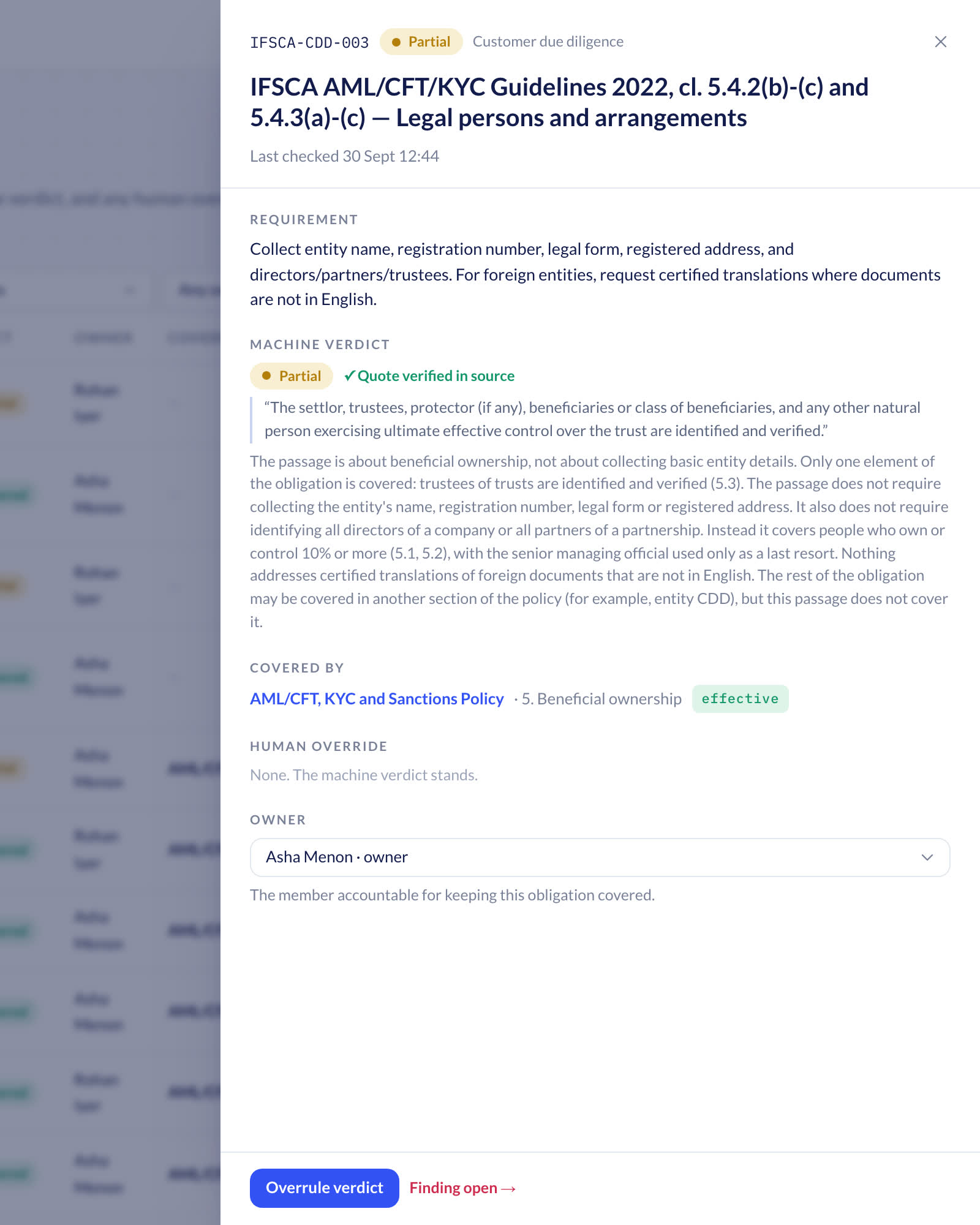
In Policy Register, the quote on a verdict is marked when it has been found word for word in the source, so a reviewer can tell a checked quotation from a paraphrase at a glance.
Covered, partial and gap
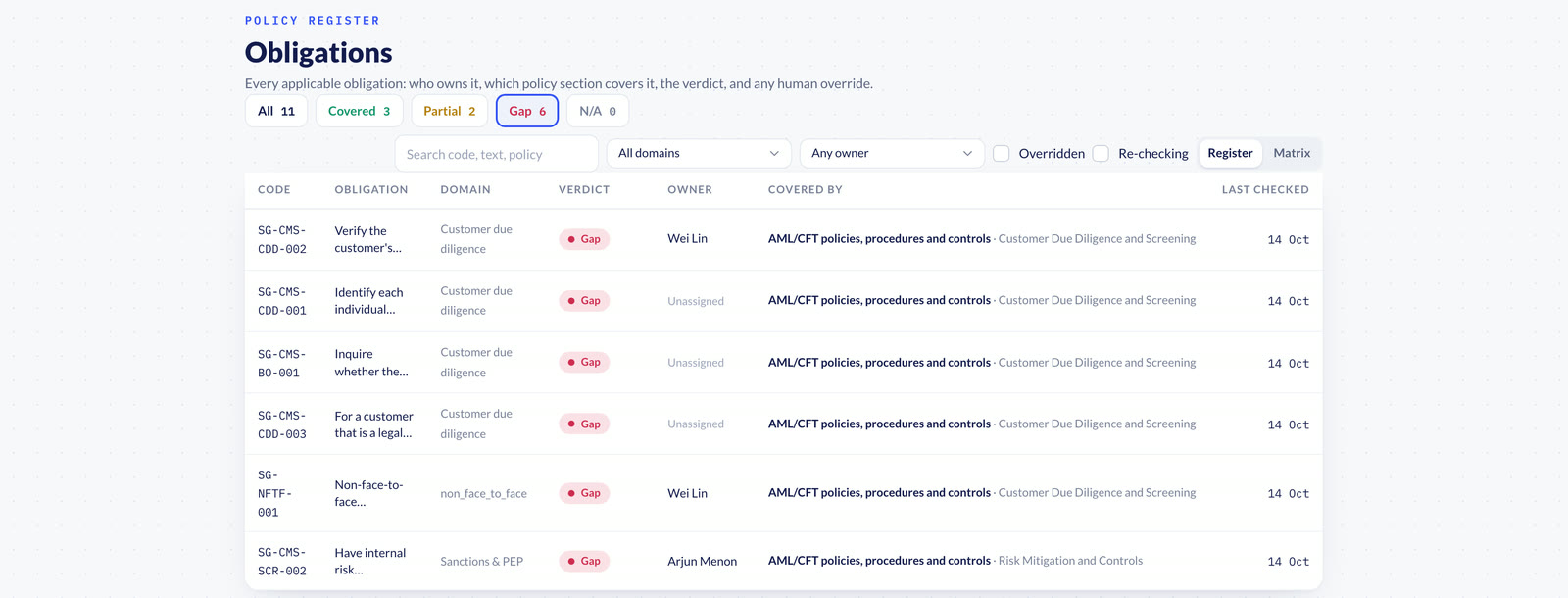
Each obligation gets one of three working verdicts, plus not applicable where a rule does not reach your licence or activities.
- Covered: an approved, effective section meets the obligation.
- Partial: a section addresses it, but leaves part of it out. The verdict says which part, so the fix is a targeted edit rather than a rewrite.
- Gap: no effective policy text addresses it.
Verdicts come from your policy text and are reviewed by your team. They are re-checked when a policy takes effect and when a rule they rest on changes, and each shows the date it was last checked. Partials and gaps also open tasks in an upgrade inbox, so they do not sit unnoticed in a report.
Owners and overrides with reasons
Every obligation has an owner: the person accountable for keeping it covered. Ownership is what turns a gap from a finding into somebody's task.
Sometimes the verdict is wrong for your firm: a rule that does not apply because you do not offer the product, or a requirement met by a procedure the register does not hold. An authorised person can overrule the verdict, but only with a written reason. The override is recorded with who made it and when, it is shown next to the original verdict rather than replacing it, and it stands until the rule's text changes, when the obligation is assessed again. An inspector sees both the judgment and the reasoning.
Where each answer lives
It helps to test a register against the questions you expect, before an inspector asks them. If the answer to any of these is "we would have to put that together", the register is not yet doing its job.
| The inspector asks | Where the answer is |
|---|---|
| Which of our rules does this policy address? | The obligation trace: each requirement, its citation, the covering section and the verdict |
| Which rules does nothing address? | The register filtered to gaps, each with an owner |
| Who decided this rule does not apply to you? | The override on that obligation: who, when and the written reason |
| Was this version approved, and by whom? | The approval evidence: stage, decision, signer and any board resolution |
| What did the policy say on a past date? | The version history, with the dates each version was in force |
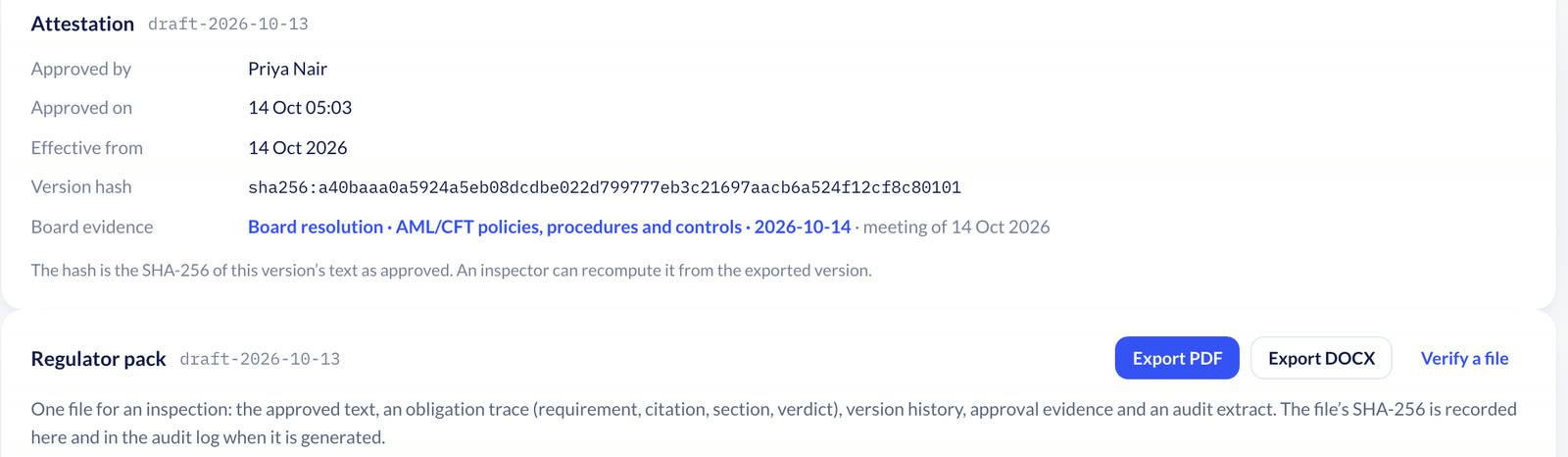
| How do we know this file is the one you approved? | The recorded SHA-256 of the pack, and the hash of the approved text |
Showing an inspector
The register earns its keep on inspection day. Three things make the evidence checkable rather than merely presentable.
An expiring, read-only link
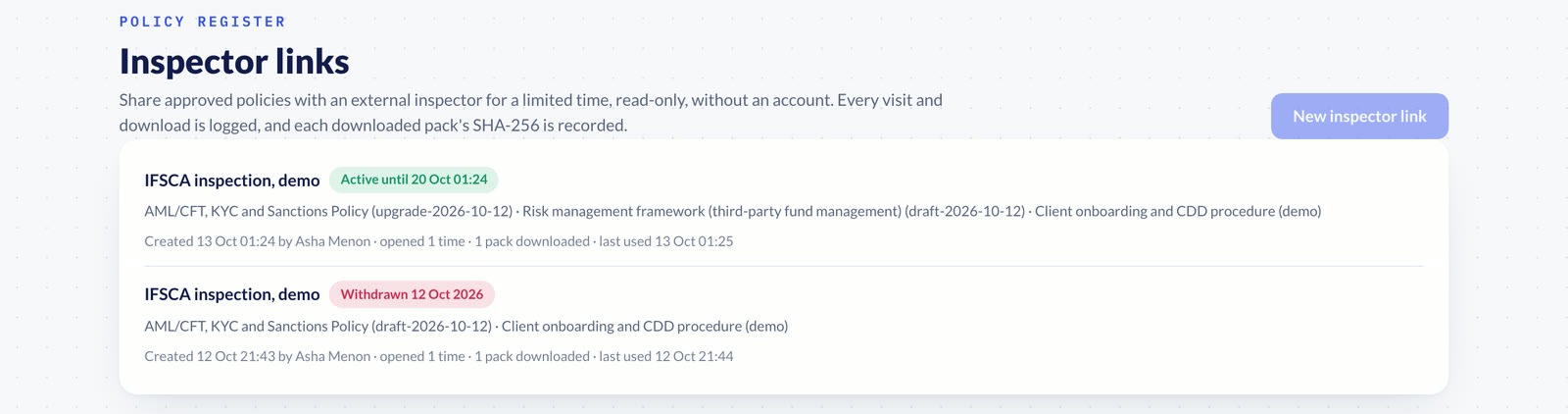
An administrator can share chosen approved, effective or superseded policy versions with an external inspector through a link that lasts from 1 to 30 days. The inspector needs no account and can only read. The link can be withdrawn at any time, and visits and downloads are recorded.
A regulator pack with a SHA-256
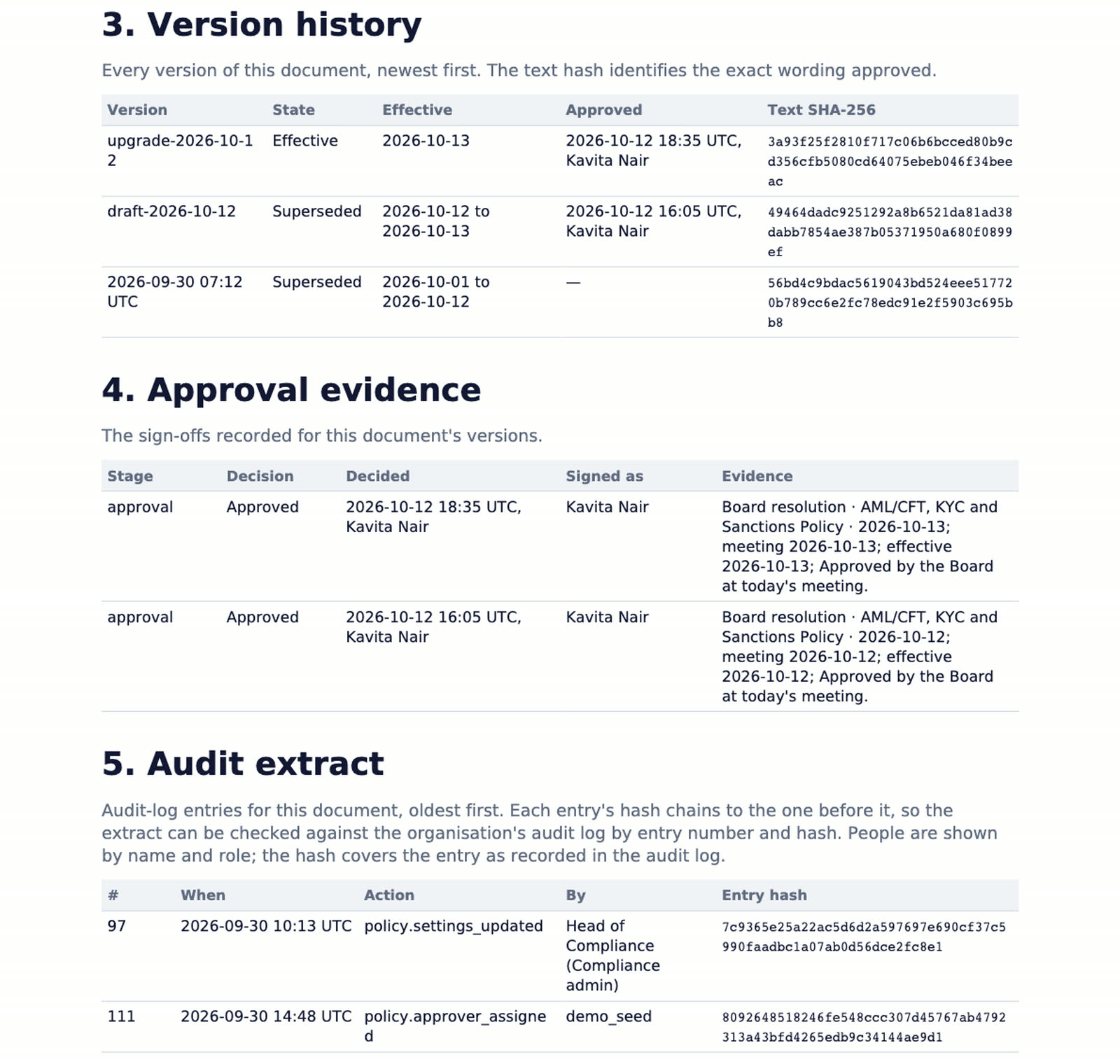
For each approved version you can export a regulator pack, as PDF or DOCX. It holds the approved text with your firm's facts filled in, an obligation trace (each requirement, its citation, the section that covers it and the verdict, with overrides marked), the version history, the approval evidence including board resolutions, and an extract of the audit trail. The SHA-256 of every pack is recorded when it is generated. Later, anyone in your team can check a file against that record: if a single byte has changed, it will not match.
The audit trail, in plain words
Every change of state is written to an append-only audit log: a draft submitted, a review completed, a version approved or taking effect, an override, a pack exported, an inspector link created or withdrawn. Each entry is linked to the one before it, so removing or editing an old entry breaks the chain and shows. The pack's extract carries the entry numbers and their hashes, so an inspector can match it against the log rather than taking the firm's word for it.
Policy Register
Clause-level mapping for IFSCA-regulated entities and Singapore fund management companies, with owners, reasoned overrides and inspector-ready evidence.
See the obligations register →Frequently asked questions
What is clause-level mapping?
Linking each section of a policy to the specific provision it satisfies, named by instrument and paragraph, with the regulator's words quoted exactly, instead of linking a whole document to a whole regulation.
How is coverage decided?
From your policy text, reviewed by your team. Each obligation gets a verdict of covered, partial or gap with the passage it relied on, and an authorised person can overrule any verdict with a written reason.
Can an inspector see our policies without an account?
Yes. An administrator can create a read-only link to chosen approved versions that expires after 1 to 30 days. The inspector opens it without an account and can download a regulator pack for each document; visits and downloads are recorded, and the link can be withdrawn at any time.
How do we prove a pack wasn't altered?
The SHA-256 of every regulator pack is recorded when it is generated. Checking a file against that record shows whether it is exactly the pack that was produced, and when it was produced. Each approved version's text carries its own hash too.
Related reading
- AML policy management for GIFT City and Singapore
- AI policy drafting you can defend to an inspector
- A buyer's guide to policy management for regulated fintechs
- About the author, Shubham Khandelwal
Walk through an inspection
See the register, a regulator pack and an inspector link on demo data for an IFSCA entity or a Singapore fund manager.
Book a demo →General information, not legal advice. Screenshots show demo data for fictitious entities.
Source: Monetary Authority of Singapore (mas.gov.sg); MAS publications as obtained from the MAS website for the corpus release of 2 September 2026. For the latest version, see mas.gov.sg. Omnified is not affiliated with or endorsed by the Monetary Authority of Singapore. MAS's published text is authoritative and prevails over anything shown here; consult mas.gov.sg.
See the orchestration engine in action.
A guided walkthrough with our team.