Policy Management Software for Regulated Fintechs
A buyer's guide for licensed fintechs: why document managers fall short, six capabilities to demand, how needs differ for a new licensee and an established firm, and the questions to put to any vendor.
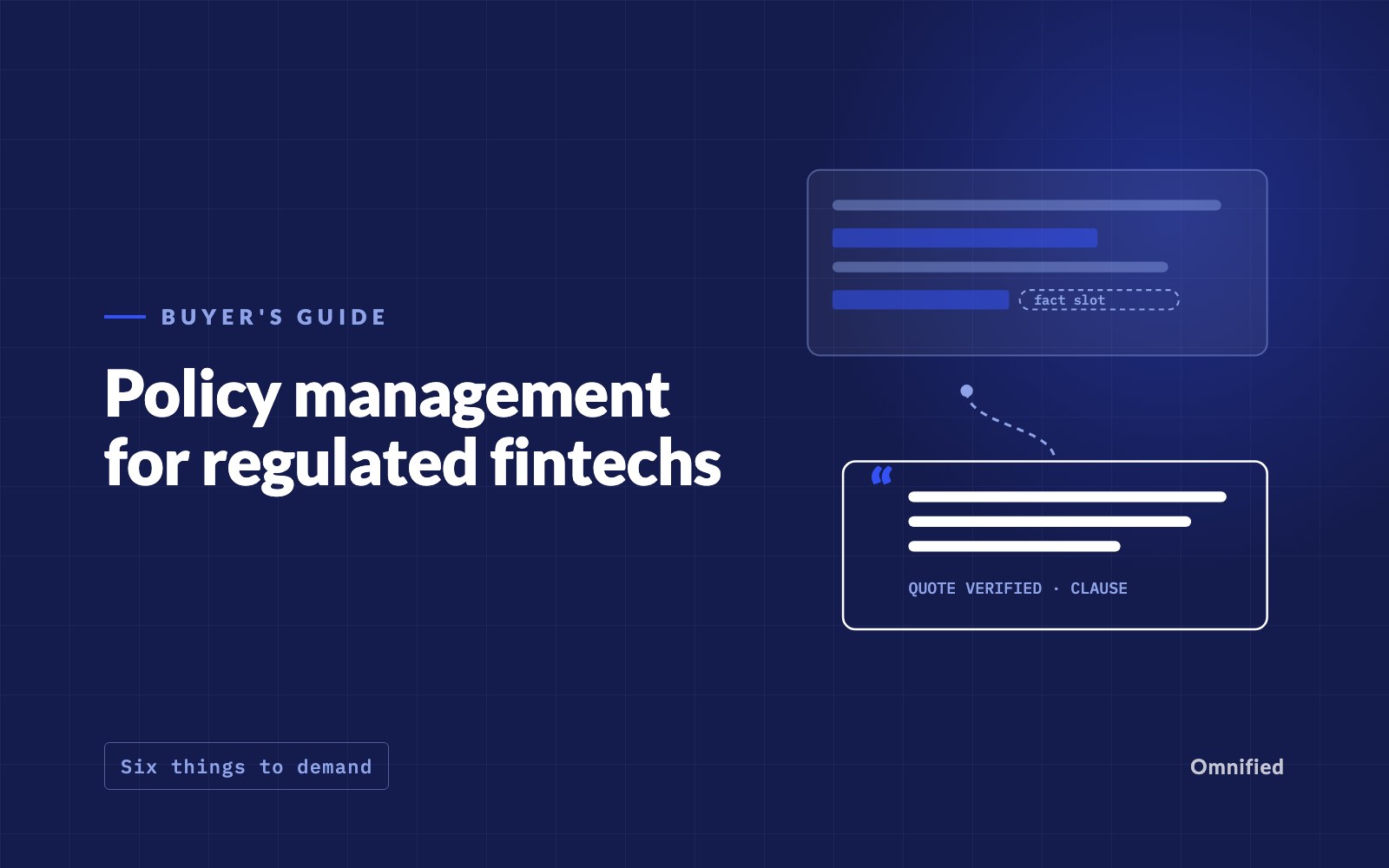
Short answer. Policy management software for a licensed fintech has to do more than store documents. It should tell you which policies your regulator requires, tie each policy to the clauses it satisfies, use AI only under human approval, enforce maker-checker and record board sign-off, get staff to acknowledge what binds them, and produce evidence an inspector can verify independently. This guide explains each of those, and the questions that separate a tool that does them from one that says it does.
Why document managers fail licensed entities
Document management systems and general GRC suites are built around files: upload, version, route for approval, set a review date. That is necessary, and for an unregulated company it may be enough. A licensed entity is judged on something else: whether its policies meet its regulator's rules, today, and whether it can prove they did on any past date.
A file-based tool leaves that link in someone's head or a spreadsheet. The mapping between a paragraph and the rule it answers is not recorded, so when a rule changes nothing tells you which policies are affected. Approval is an e-mail or a checkbox, not evidence of who decided what. And the pack you hand an inspector is assembled the week before, from whatever you can find.
There is a second cost. Every hour a small compliance team spends reconciling which file is current, chasing approvals by e-mail and rebuilding evidence is an hour not spent on the judgment calls that a regulator actually examines: risk assessment, customer decisions, monitoring. Tools should take the clerical work, not add to it.
Six things to demand
1. It tells you which policies you need
The first question a new licensee asks is "what must we have?" Good software answers it from the regulator's text for your licence, activities and customers, not from a generic checklist. Each required policy should come with the clause that mandates it, the approving body and the review cadence, and guidance-based items should be marked as recommended, not required. Where the answer depends on a fact, such as whether you onboard by video, it should ask rather than assume.
2. Clause-level mapping
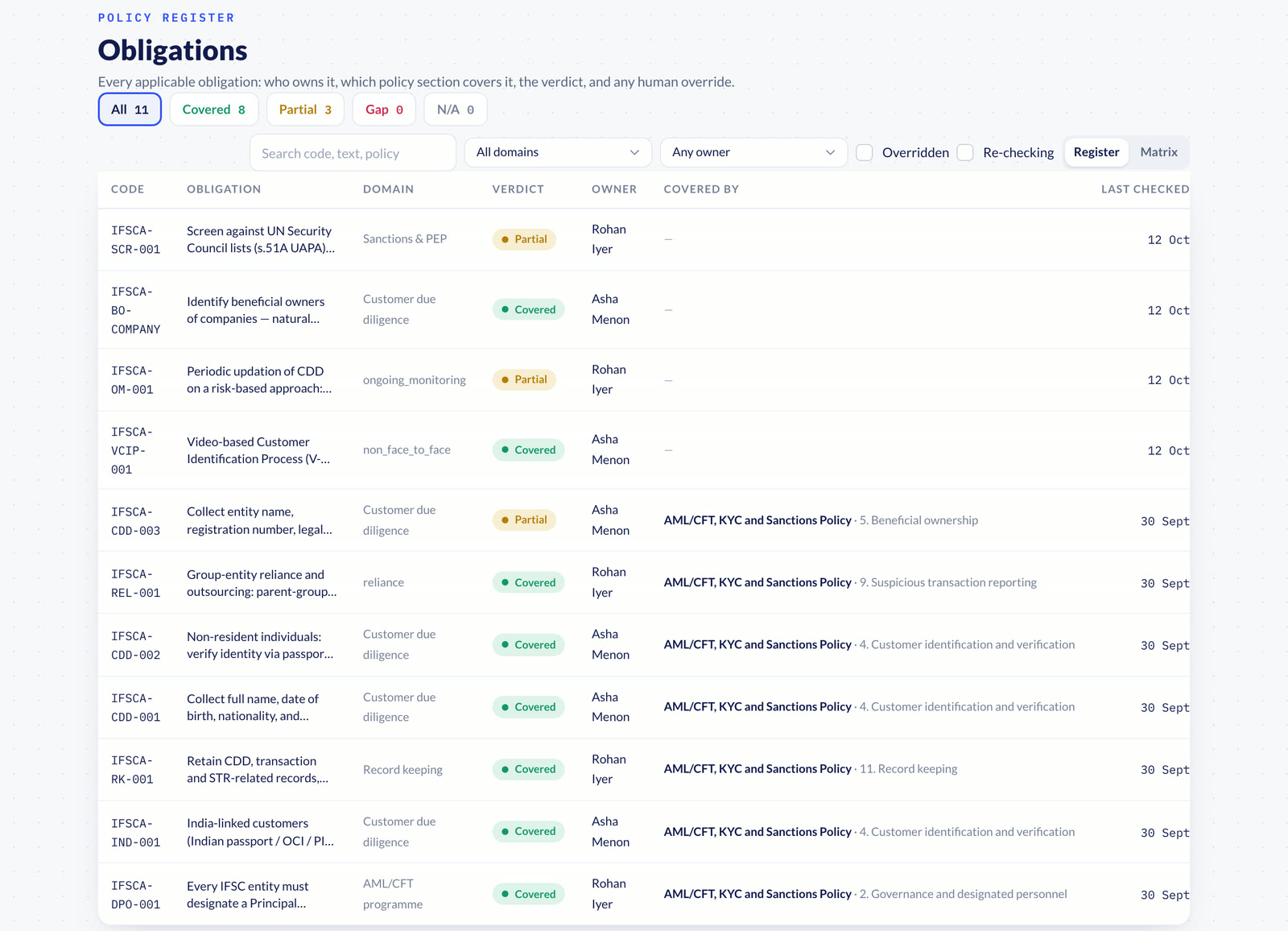
Every obligation should link to the policy section that meets it, with the regulator's words quoted exactly and the instrument and paragraph named. Each link needs a verdict (covered, partial or gap), an owner, and the date it was last checked. A human must be able to overrule a verdict, with a reason that is kept.
3. AI with human approval
AI drafting is worth having only if each sentence shows where it came from: the regulator's binding text, the regulator's guidance, your firm's facts, or your firm's choices. Quotes presented as the regulator's must be verifiable word for word, drawn only from rules addressed to your licence. Facts only your firm knows should be left as blanks to fill, never guessed. And nothing the AI produces should reach a live policy without a named person approving it.
4. Maker-checker and board sign-off
The person who wrote a version must not be able to approve it, and the software should enforce that rather than rely on etiquette. Where the regulator expects board approval, the record should hold the board resolution and meeting date. The approver's sign-off should be tied to the exact text approved, so it cannot later be attached to a different version.
5. Staff acknowledgement
A policy binds people. You should be able to send an approved version to staff by role or by name, with a due date and reminders, and record each acknowledgement against the exact version read. Completion should be visible, and outstanding people identifiable by those responsible for chasing them.
6. Inspector-verifiable evidence
Evidence an inspector has to take on trust is weak evidence. Look for an export that bundles the approved text, the obligation trace, version history, approval evidence and an audit extract, with a cryptographic hash recorded so the file can be checked later. Look for a way to give an inspector read-only access that expires, without creating an account. And look for an audit log in which each entry is chained to the last, so history cannot be edited quietly.
A newly licensed entity versus one with 40 policies
The same tool should serve two very different starting points, and you should test it against yours.
| Newly licensed entity | Established entity with 40 policies | |
|---|---|---|
| First question | Which policies must we have before we commence? | Where does our current set fall short, and what has drifted? |
| Starting point | A required-policies list from the regulator's text, then drafts | Upload the existing policies, approve them, and see the gaps |
| Where AI helps | First drafts, section by section, with your facts as blanks to fill | Drafting only the missing or partly covered sections |
| Who approves | Often a small board and a compliance team of one | Several approvers, with board-level and management-level routes |
| Ongoing work | Getting every required policy approved and current | Keeping 40 policies current as rules and review dates move |
Questions to ask any vendor
- Which regulators, and which licence types, do you cover today? What is listed as coming soon?
- Where does your list of required policies come from, and can I see the clause behind each item?
- When a mapping says a section covers a rule, can I see the exact quote and paragraph it relied on?
- How do I overrule a verdict, and what is recorded when I do?
- Which sentences in an AI draft come from the regulator, and how can I tell?
- Can a draft ever take effect without a named approver? Can its author approve it?
- How is board approval evidenced?
- What happens when a rule my policy is mapped to changes?
- What can I give an inspector, and how would they know it was not altered?
- Who in my team can see, edit, approve and export, and is that enforced or only displayed?
Red flags in a demo
A demo is designed to go well. These are signs that the hard parts are not there:
- Mapping shown only at document level: "this policy covers AML", with no clause or quote.
- AI text with no indication of which sentences come from the regulator and which were generated.
- An approval that is a status change anyone with edit rights can make, including the author.
- "Regulatory updates" that are a news feed, with no link to the policies a change affects.
- An export that is a PDF of the document and nothing else: no trace, no approvals, no history.
- Coverage claims for many regulators with no way to see which licence types each one covers.
How Policy Register answers them
Omnified's Policy Register covers IFSCA-regulated entities in GIFT IFSC and, in Singapore, fund management companies only. Other regulators on our coverage list are not yet mapped.
Where to start depends on where you are. A newly licensed entity usually starts with the Blueprint, answers its questions, and drafts the required policies one at a time, approving each as it is finished. An established entity usually uploads its current policies first, approves them as the baseline, and works through the gaps and partials the coverage run reports. Either way, the register fills in as policies are approved, and the upgrade inbox takes over from there.
- Required policies: the Blueprint lists them for your licence, activities and customers, each with its mandating clause, approving body, review cadence and status; guidance-based items are recommended.
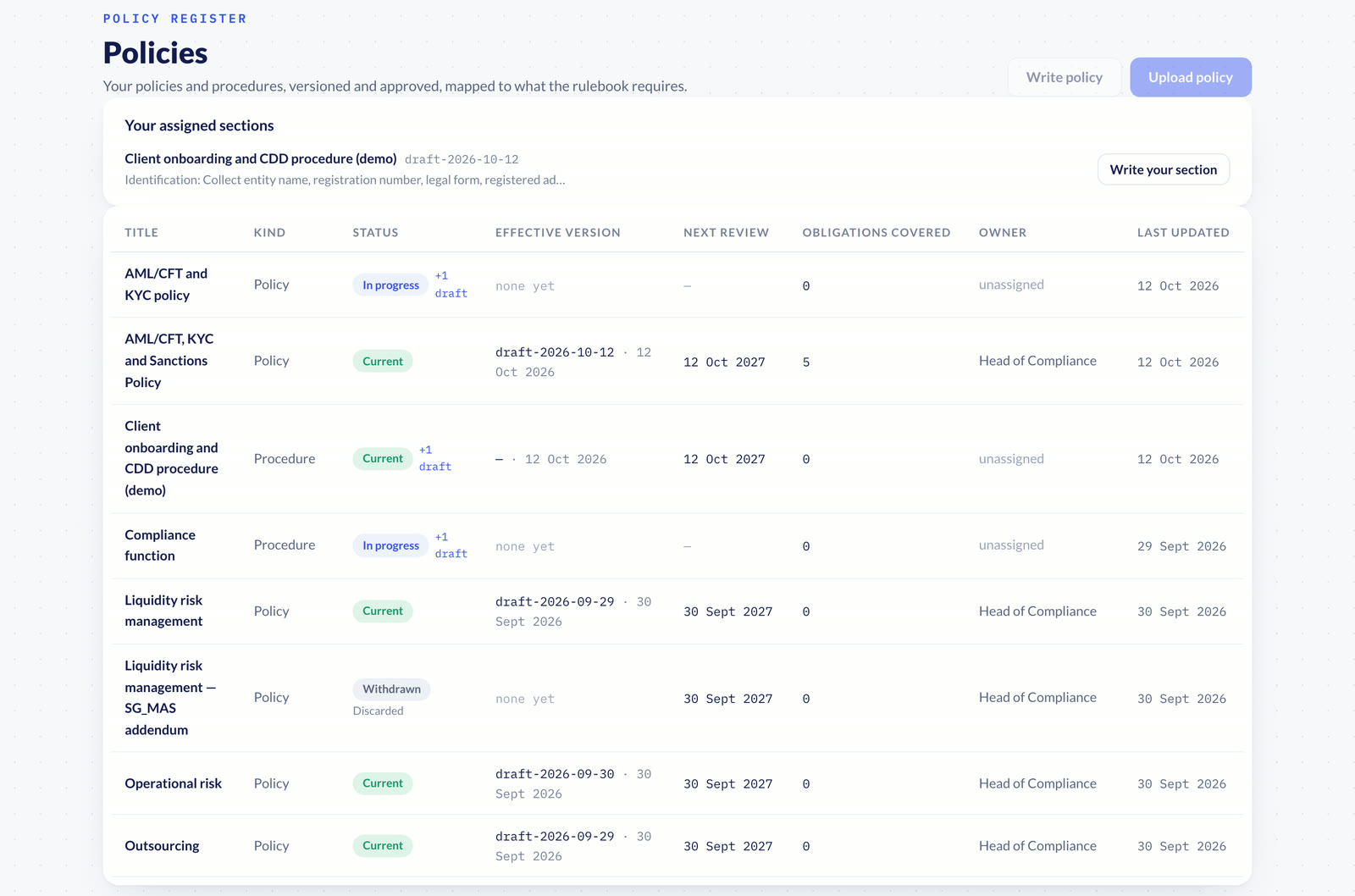
- Mapping: every obligation shows its citation, a verdict from your policy text that your team reviews, the covering section, an owner and the last-checked date; overrides need a reason and are recorded.
- AI drafting: drafted text is tagged regulator-derived (with a verbatim quote), regulator guidance, entity fact or firm choice; your facts are slots; every draft goes to approval.
- Approval: the author cannot approve; board-level policies go through compliance review and an approver's sign-off with the board resolution and meeting date.
- Change: rule changes, review dates and coverage gaps open tasks in an upgrade inbox; starting one redrafts only the affected sections, as a new draft for approval.
- Evidence: a regulator pack in PDF or DOCX with its SHA-256 recorded, an expiring read-only inspector link, and a hash-chained audit log.
- Acknowledgement: staff acknowledgement is an add-on, enabled per organisation.
Policy Register
The policies your regulator requires, drafted from its own text and mapped clause by clause, for IFSCA-regulated entities and Singapore fund management companies.
Read the Policy Register overview →Frequently asked questions
What is a policy register?
A record of an entity's policies tied to the regulatory obligations they meet: for each obligation, the approved policy section that covers it, the clause it rests on, how well it is met, who owns it and when it was last checked, with the version history and approvals behind each policy.
Do fintechs need board-approved policies?
Often, but it depends on the regulator and the policy. In GIFT IFSC, the IFSCA (AML, CFT and KYC) Guidelines, 2022 require the AML-CFT policy to be approved by the governing body or a committee it has delegated. In Singapore, MAS Notice SFA04-N02 requires a fund management company's AML/CFT policies, procedures and controls to be approved by senior management. Check the approving body each requirement names.
Can software tell me which policies my regulator requires?
Yes, if it works from the regulator's text for your licence rather than a generic list. Policy Register's Blueprint does this for IFSCA-regulated entities and Singapore fund management companies, with the clause behind each item. Treat it as the starting point for your compliance team and counsel, not a substitute for them.
Is AI-drafted text acceptable?
What matters is the approved policy and who stands behind it. AI-drafted text is usable when your team has reviewed it, its statements of regulatory requirement trace to the regulator's own words, your firm's facts and choices are your own, and a named approver has signed it off.
Related reading
- Draft, map and track compliance policies to regulation: seven steps
- Four rules for AI policy drafting in fintech compliance
- AML policies for GIFT City and Singapore fund managers
- About the author, Shubham Khandelwal
Put these questions to us
Bring the vendor questions above. We will answer each on demo data for your regulator.
Book a demo →General information, not legal advice. Screenshots show demo data for fictitious entities.
Source: Monetary Authority of Singapore (mas.gov.sg); MAS publications as obtained from the MAS website for the corpus release of 2 September 2026. For the latest version, see mas.gov.sg. Omnified is not affiliated with or endorsed by the Monetary Authority of Singapore. MAS's published text is authoritative and prevails over anything shown here; consult mas.gov.sg.
See the orchestration engine in action.
A guided walkthrough with our team.